
Titus Morebu
Author
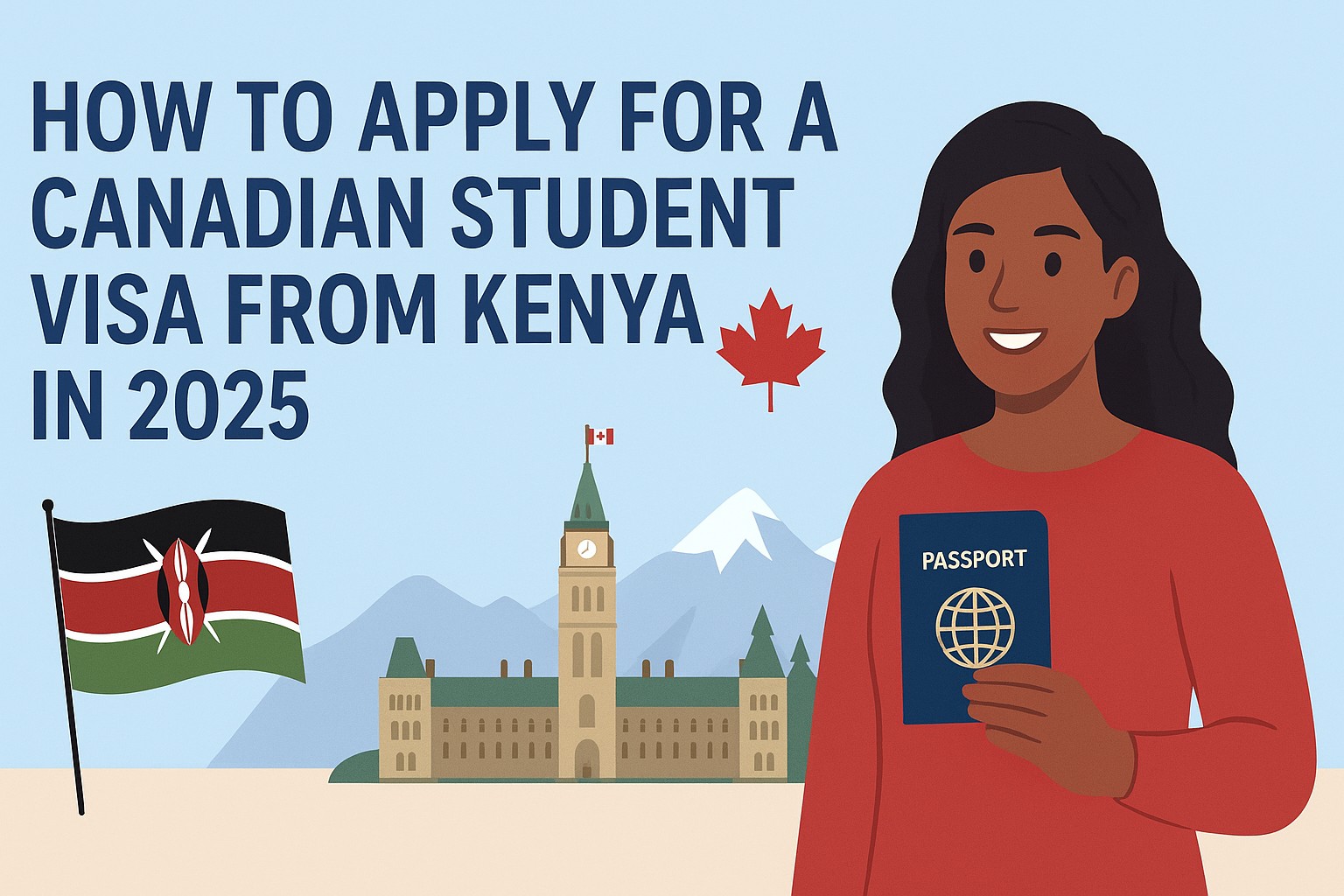
How to Apply for a Canadian Student Visa from Kenya in 2025 🍁
Learn the complete, up-to-date process, requirements and tips for Kenyans applying for a Canadian study permit in 2025. Stay ahead with changes and best practices.
Thinking of studying in Canada from Kenya? This guide walks you through each step of applying for a Canadian student visa (study permit) from Kenya in 2025 — with clarity, updated requirements, and tips to boost your chances. 🎓
Why Canada? Benefits for Kenyan Students
- World-class universities and colleges with global recognition.
- Possibility of part-time work while studying (on- or off-campus).
- Post-graduation work permit (PGWP) options as a path to Canadian work experience.
- Multicultural society, safety, and quality of life.
- Opportunity to eventually apply for permanent residency through Canadian immigration pathways.
Recent Policy Updates & What You Must Know
Visa rules evolve, and 2025 has seen notable changes:
- Canada has introduced a cap on new international student permits. In 2025 new permits are limited to ~ 437,000. 🎯
- Proof of funds requirement has been increased: the amount you must show to support yourself (tuition + living costs) is higher than before.
- You’ll often need a **Provincial/Territorial Attestation Letter (PAL/TAL)** along with your study permit, especially under the new caps.
- Applications for study permits must generally be submitted **online** unless you qualify for a paper process due to disability or special status.
Step 1: Secure Admission from a Designated Learning Institution (DLI)
This is your foundation. Without it, your application is likely to be refused.
- Choose a college, university, or language school in Canada that is a **Designated Learning Institution (DLI)**. If the school is not a DLI, your student permit will be denied.
- Receive an **official acceptance letter** from that institution. This must clearly state your course, start date, fees, etc.
- If your province requires it, obtain the **Provincial Attestation Letter (PAL)** or **Territorial Attestation Letter (TAL)**. Many students from Kenya now need this in 2025.
Step 2: Check Eligibility Criteria 📋
Before applying, ensure you meet these minimum criteria:- Valid Kenyan passport with sufficient validity (preferably covering your entire study period).
- Clear criminal record; immigration admissibility.
- Good health (a medical exam may be required).
- Proof you can financially support yourself: tuition, living expenses, return transportation, etc.
- Intent to leave Canada after your studies (non-immigrant intent, unless you pursue lawful status later).
Step 3: Prepare Your Documents
Organize these essentials carefully — missing or weak documentation is a common reason for refusal.Here’s a robust checklist you should assemble:
- Completed application forms via the IRCC portal (or paper forms, if applicable).
- Valid passport (and copies of biodata page, any prior visas).
- Your acceptance letter from a DLI, and PAL/TAL if required.
- Proof of funds:
- Bank statements (savings, fixed deposits).
- Education loan sanction letters (if applicable).
- Sponsorship letters (if a parent or guardian is funding you).
- Any financial guarantees or affidavits.
- Academic transcripts and certificates (secondary school, university, etc.)
- Language test results (IELTS, TOEFL, or other acceptable test if required by the institution).
- A strong **letter of explanation** or **statement of purpose**: why you chose the program, how it fits your career, why Canada, how you intend to support yourself.
- Medical exam results (if required by IRCC for Kenya applicants).
- Biometric information (fingerprints + photo) — you’ll be asked to provide after application submission.
- Passport-size photos (according to IRCC specs).
- Any additional documents requested by the Canadian visa office for Kenya (check with your nearest Visa Application Centre or IRCC Kenya guidance).
Step 4: Submit Your Application Online (or Paper, in Special Cases)
Online submission is strongly preferred and quicker in most cases.
- Create an account on the IRCC application portal and start your study permit application.
- Answer the eligibility questions — you’ll be guided to which forms you need.
- Upload your documents in the specified places (acceptance letter, financial proof, etc.).
- Pay the required fees (application + biometric fees). These are non-refundable, so double-check your application before paying.
- Submit. Your processing time “clock” begins when the IRCC receives a **complete** application. ⏰
If you are unable to apply online (due to disability or specific status), you can use the paper route, but approve eligibility first.
Step 5: Biometrics & Additional Requests
Once your application is under review, you’ll likely receive a **biometrics request** from IRCC.
- You have 30 days (from request date) to go to a Visa Application Centre (VAC) in Kenya to submit fingerprints and a photo.
- If IRCC requires more documents or an interview, respond promptly to avoid delays.
Step 6: Processing & Decision
What to expect as you wait:
- Processing times vary by country and season — check the IRCC “Check processing times” tool often. ⏳
- If your application is **approved**, IRCC issues a “Letter of Introduction” (port-of-entry letter) and sometimes a visa vignette in your passport if required.
- You’ll need to present that letter plus your passport At the Canadian port of entry to receive your actual study permit.
- If **refused**, IRCC provides reasons. Use that feedback to fix issues and reapply.
Step 7: Before Departure: Preparations & Entry to Canada
These steps help you arrive smoothly:
- Buy health insurance or ensure policy coverage for when you arrive in Canada.
- Arrange housing and transport for your first weeks.
- Carry important documents:
- Letter of Introduction / Port-of-entry letter
- Study permit approval (if issued beforehand)
- Acceptance letter from your school, fees receipts
- Proof of funds
- Passport with visa (if required)
- Any medical documentation
- At the Canadian border, the immigration officer will verify your documents and issue your study permit.
Optional: Bringing Dependents to Canada
If you’ll bring your spouse or children, here’s what you should know:
- You may apply for dependent visas for your spouse and dependent children.
- Your spouse might be eligible for open work permit (in certain conditions) while you study.
- Dependents must also prove funds, identity, and admissibility.
- Initiate these applications as early as possible — their processing runs in parallel.
Tips to Improve Your Student Visa Approval Odds ✅
- Submit a **complete** application. Missing documents are a top cause of refusal.
- Be truthful and consistent. Contradictions in your form, academic history, or finances will hurt trust.
- Show strong financial depth — more buffer than just the minimum is safer.
- Craft your Letter of Explanation thoughtfully — explain your academic path, your intent to return or legitimate next steps.
- Apply early (months ahead), because delays or requests for information may occur.
- Keep valid travel history or prior visas (if any) to demonstrate responsible travel behavior.
- Maintain honest communication with IRCC, respond quickly to requests for document updates.
Common Problems & How to Handle Them
- Insufficient proof of funds: Provide more documentation; show a combination (bank, loan, sponsor).
- Missing PAL/TAL: Verify with your province or institution whether it’s required and acquire it early.
- Medical or health issues: If flagged, get the required medical exams at IRCC-listed panel physicians.
- Certificate or transcript discrepancies: Clarify discrepancies in a cover letter or with official clarifications from your previous institutions.
- Delays or incomplete applications: Monitor your IRCC account and VAC communications, respond quickly to “webform” requests.
Conclusion
Applying for a Canadian student visa from Kenya in 2025 is entirely feasible — but success depends on preparation, documentation, and timeliness. Start early, be thorough, and follow each step carefully. Canada offers wonderful opportunities, and with diligence you can make your academic dreams a reality. Good luck! 🇨🇦
Want to double-check your application before submission or get personal guidance? Consider seeking advice from certified immigration consultants or use official IRCC support channels.
🔗 Useful Resources:
Gallery
Related Articles
3 articles
Best Free Learning Apps for Kenyan Students in 2025
Discover powerful free learning apps for Kenyan students — from curriculum-aligned platforms to global resources that work offline and on low-data connections.
How to Land an Internship in Kenya: A Step-by-Step Guide to Success 🚀
Discover the most effective strategies to secure internships in Kenya—eligibility, applications, channels, preparation, visa tips—and stand out in 2025.
How to Write a Winning CV in Kenya: A Complete 2025 Guide
Learn how to craft a professional, ATS-friendly CV suited to Kenya’s job market. Get structure, formatting, content tips, and example frameworks to help you land interviews.