
Titus Morebu
Author
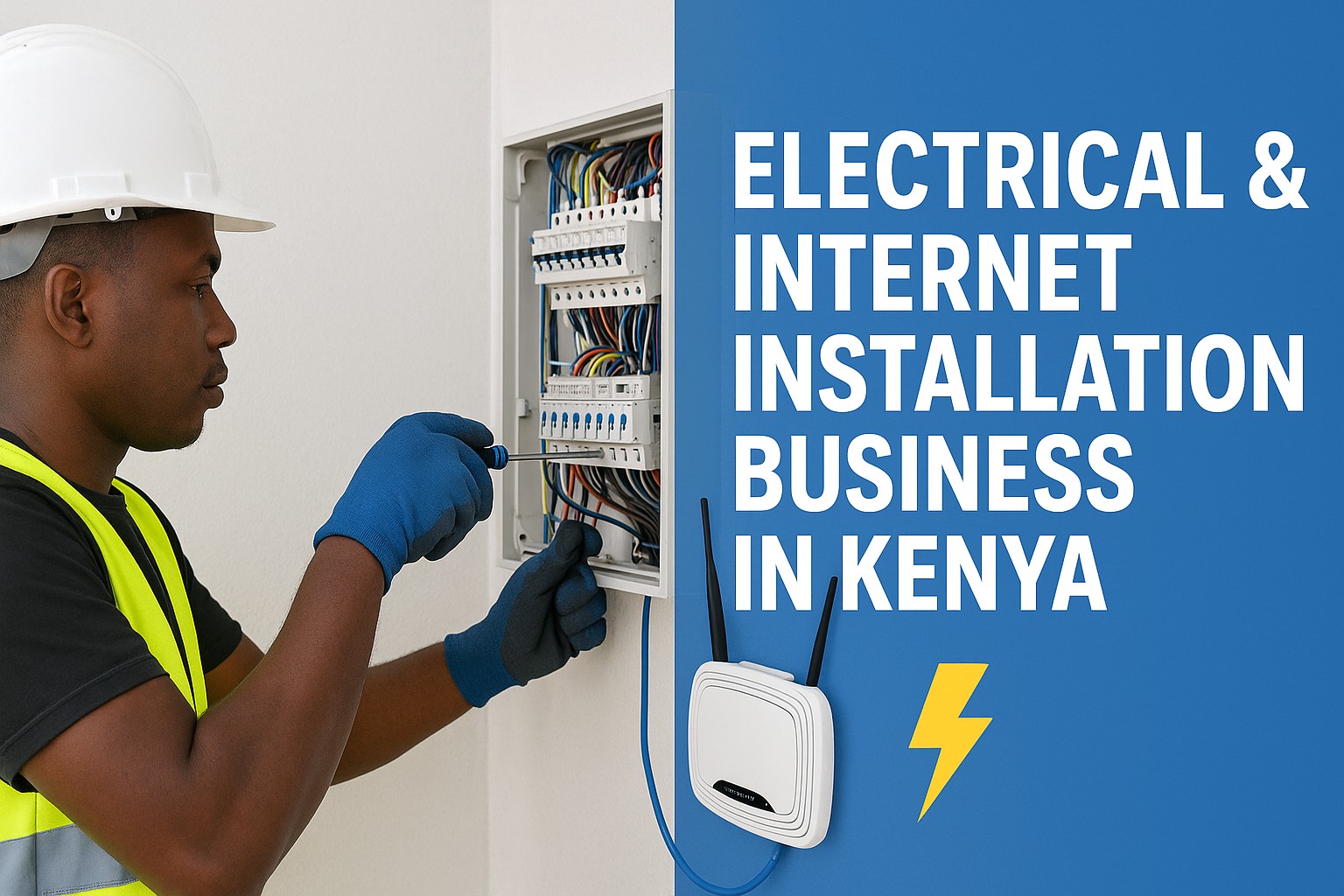
Electrical & Internet Installation Business in Kenya: How to Launch & Succeed 💡
Build a profitable electrical + internet installation business in Kenya: from market analysis, service mix, licensing, operations, marketing, to scaling for sustainable growth.
Why Electrical & Internet Installation Is a Smart Business in Kenya
In recent years, Kenya has seen a rapid digital transformation. Businesses, homes, institutions, and even rural communities require dependable power and connectivity. ⚡📶 This dual-service niche—providing both electrical installations and internet/networking infrastructure—is uniquely poised to capture high growth demand and deliver recurring revenue through support contracts.
Key Market Drivers
- Rapid digitalization: As more services move online, reliable connectivity is critical.
- Urbanization & expansion: New housing developments, commercial buildings, shopping malls all need wiring and networks.
- Institutions & public sector: Schools, hospitals, government agencies are investing heavily in ICT infrastructure.
- Recurring income potential: Maintenance, upgrades, service contracts, and monitoring all generate steady cash flow.
- Bundling advantage: Offering both power and connectivity solutions gives you cross-sale opportunities and better margins.
Typical Services You Can Offer
You should aim to offer a broad portfolio to diversify revenue streams. Examples include:
- Electrical wiring, panels, switches, lighting, power backup (UPS, generators, solar hybrid)
- Structured cabling (Ethernet, Cat6, Cat6a), data cable installation and termination
- Fiber optic installation, splicing, termination, backbone networks
- WiFi infrastructure design & deployment, access point installation
- Network hardware setup (routers, switches, patch panels, VLANs)
- Network testing, certification, performance audit
- Security wiring (CCTV, access control, alarms) integrated with network
- Service & maintenance contracts, troubleshooting, upgrades
How to Start Your Business — Step by Step
1. Market Research & Niche Definition
Don’t try to be “everything to everyone” from day one. Choose a niche (e.g. residential fiber + WiFi, or commercial structured cabling) and dominate it locally before expanding. Look at gaps in your city or county: is there insufficient fiber service in suburbs, or unreliable WiFi in offices?
2. Licensing, Compliance & Standards
Ensure you register your business with the relevant Kenyan authorities (e.g. the Registrar of Companies). Also:
- Obtain electrical contracting license / electrician certification (by the relevant technical board).
- Comply with national electrical standards (wiring codes, safety, earthing).
- Adhere to network cabling & fiber standards (TIA/EIA, ISO benchmarks).
- Ensure your installations pass inspections and can withstand harsh climate, dust, humidity.
3. Equip Your Tool Kit & Procurement
Your capital investment will include:
- High quality cable (Cat6, Cat6a, fiber, patch cords)
- Splicing tools, fusion splice machines, OTDR testers
- Multimeters, insulation testers, wire strippers, conduit benders
- Network gear (switches, routers, access points, patch panels)
- Safety gear, ladders, cable trays, conduits
- Backup power systems (UPS, inverters, solar kits)
Find reliable suppliers in Kenya who stock international brand equipment — this ensures quality and faster replenishment.
4. Building a Team & Training
Your business will live or die by your technicians. Steps to take:
- Recruit certified electricians and network technicians.
- Invest in training: fiber splicing, network certifications (e.g. Cisco, Ubiquiti, CompTIA).
- Ensure safety training and compliance, especially working at heights or on electricity.
- Start with a small crew (2–4) and scale as you win contracts.
5. Pricing Strategy & Costing
Set your prices to cover material costs, labor, overhead, and some buffer for contingencies. Strategies:
- Package pricing: e.g. “full WiFi + fiber install” instead of itemizing every cable.
- Per meter / per point rates: for cabling, terminations, patching.
- Markup on materials: small percentage over supplier cost.
- Annual maintenance contracts: fixed monthly or quarterly retainer fees.
6. Marketing & Lead Generation
Your business must be visible to clients. Effective strategies include:
- Create a professional website optimized for local SEO (e.g. “electrical installation Nairobi”).
- Use Google My Business / local listings to appear in maps and local search.
- Partner with real estate developers, contractors, and architects who can refer projects.
- Show completed project portfolios with before/after photos.
- Use social media (LinkedIn, Facebook) to showcase technical insights and client stories.
- Offer free site surveys or diagnostics to entice leads.
7. Execution & Quality Assurance
When on site:
- Do a proper site survey and plan cabling/routes before drilling.
- Label every cable and maintain documentation of the network layout.
- Always test cable runs (continuity, attenuation, signal strength).
- Follow safety, tidiness, and aesthetic standards – clients notice clean installations.
- Demo to client, hand over documentation and network diagrams.
Scaling and Sustainability
Recurring Revenue Models
These help your cash flow and business valuation:
- Support & maintenance contracts (network uptime, repair)
- Upgrades — e.g. improving CAT6 → CAT6a, adding fiber backbone
- Service level agreements (SLAs) with guaranteed response times
- Managed services (monitoring, remote diagnostics)
Expanding Geographically
- Start within your city or county, then branch to satellite offices.
- Partner with local contractors in towns you wish to cover.
- Use remote support technology to assist field teams.
Investing in Branding & Trust
To win larger clients, you’ll need:
- Strong branding — logo, uniform, reliable identity
- Client testimonials and case studies
- Certifications (e.g. network vendor certifications, electrical safety)
- Insurance and guarantees on workmanship
Challenges & Risks — And How to Mitigate
1. Power Instability & Outages
Frequent power failures in some regions mean you need to design resilient systems (UPS, solar backup) so connectivity stays online.
2. Competition & Price Pressure
Many small “fundis” will compete on price. Your differentiation must be quality, reliability, warranties, and professional service.
3. Logistics & Material Delays
Stock buffer your critical materials and develop relationships with suppliers who deliver efficiently nationwide.
4. Technical Failures / Rework
Poor cabling or bad fiber splices can lead to repeat visits. Enforce quality control, testing, and technician accountability.
5. Customer Trust & Payment Delays
Especially with large clients, get partial upfront payments and clear contracts to avoid long unpaid periods.
Case Examples from Kenya
Several Kenyan firms already specialize in network infrastructure and fiber servicing. Some deliver full fiber, structured cabling, and service contracts across multiple counties. These show the demand exists and can be tapped. (High-quality installations, warranties, and reputation building are their competitive edges.)
SEO & AI-Friendly Optimization Tips
- Write naturally but include target keywords like “electrical installation Kenya”, “fiber installation Nairobi”, “network cabling services Kenya”.
- Use headings (H2, H3) that reflect search intent like “How much does fiber install cost in Kenya?” or “Best electrical installer in Nairobi”.
- Include external links (in your live blog) to high authority domains such as Wikipedia pages on fiber optics, or government ICT policy pages. Use descriptive anchor text (e.g. “learn about fiber optic standards”).
- Ensure links open in new tabs (
target="_blank") so users stay on your site. - Use alt text for any images describing them with keywords.
- Use a meta description summarizing your blog with key terms.
- Regularly update the content (cost changes, new tech) to keep freshness.
Conclusion
Starting an electrical & internet installation business in Kenya is a compelling opportunity. With the right planning, technical skill, service excellence, and marketing, you can build a high margin, recurring-revenue company that serves the core needs of Kenya’s digital infrastructure. The path isn’t trivial, but the demand is real and growing. Take one step today — get your first lead, do a quality job, and let reputation become your greatest growth engine. 🚀
Gallery
Related Articles
3 articles
How to Make Money While Sleeping in Kenya (2026)
Discover proven passive income ideas in Kenya that earn you money 24/7, even while you sleep. Learn realistic strategies, tools, and income potential.

Best Side Hustles for Students in Kenya (2026 Guide)
Discover the best side hustles for students in Kenya. Learn how to earn money online and offline with low capital and flexible schedules.

Trending Businesses in Kenya Right Now (2026 Guide)
Discover trending businesses in Kenya right now in 2026. Learn profitable ideas, startup costs, and how to succeed in today’s evolving economy.